The Ultimate Roofing Marketing Guide (2026)

The State of Roofing Marketing in 2026
If you own a roofing company, you're competing in one of the most expensive and competitive local service industries in America.
Homeowners no longer rely on one source to choose a roofer. They search Google, check Google Maps, read reviews, ask ChatGPT, compare websites, watch videos, and ask neighbors before ever making a phone call.
This guide brings everything together in one place so you can build a marketing system that continues generating leads long after the work is done.
Today, in 2026, we are navigating another massive shift. Search behavior has evolved. Homeowners are no longer just typing keywords into Google and clicking the first blue link. They are asking complex questions to AI tools like ChatGPT, Gemini, and Perplexity. They are relying heavily on the Google Local Pack (Maps) and Google AI Overviews. They are reading dozens of reviews and seeking out educational content before ever making a phone call.
If your roofing marketing strategy still relies entirely on buying shared leads from platforms like Angi, or running expensive Google Ads without an organic foundation, you are fighting a losing battle. You are renting attention instead of owning it, and competing on price instead of authority.
At Media Surge Marketing, our philosophy is simple: Visibility before rankings. Authority before advertising. Education before selling. This guide is the definitive resource for roofing company owners, sales managers, and marketing directors who want to build sustainable, compounding digital authority. We will break down exactly what works in 2026, from Local SEO to AI Search Visibility, and how to implement a system that generates exclusive, high-intent leads.
| Traditional Roofing Marketing | Modern Roofing Marketing (2026) |
|---|---|
| Door Hangers & Flyers | Google Business Profile (Maps) |
| Cold Calling | AI Visibility & AEO |
| Yellow Pages & Print Ads | Local SEO & Service Area Pages |
| Buying Shared Leads (Angi) | Owned Digital Authority |
The Roofing Buyer Journey Framework
Before you can market effectively, you must understand buyer psychology. A new roof is a massive, high-ticket purchase—often between $10,000 and $25,000. Homeowners do not make this decision lightly unless it is an absolute emergency.
The modern buyer journey typically follows this framework:
- The Trigger: The homeowner notices a leak, sees storm damage, or realizes their roof is simply at the end of its lifespan.
- The Initial Search (Google & AI): They search for information. They might ask Google, "How much does a new roof cost in [City]?" or ask ChatGPT, "What are the best roofing companies near me that specialize in architectural shingles?"
- The Evaluation (Google Maps & Reviews): They look at the Google Local Pack. They check star ratings. They read the actual text of the reviews to see if previous customers mentioned punctuality, cleanliness, and fair pricing.
- The Deep Dive (Website & Content): They visit the websites of the top 2-3 contractors. They look for trust signals: real photos, team bios, clear service pages, and educational content that answers their specific questions.
- The Decision: They request quotes from the companies that built the most trust during the research phase.
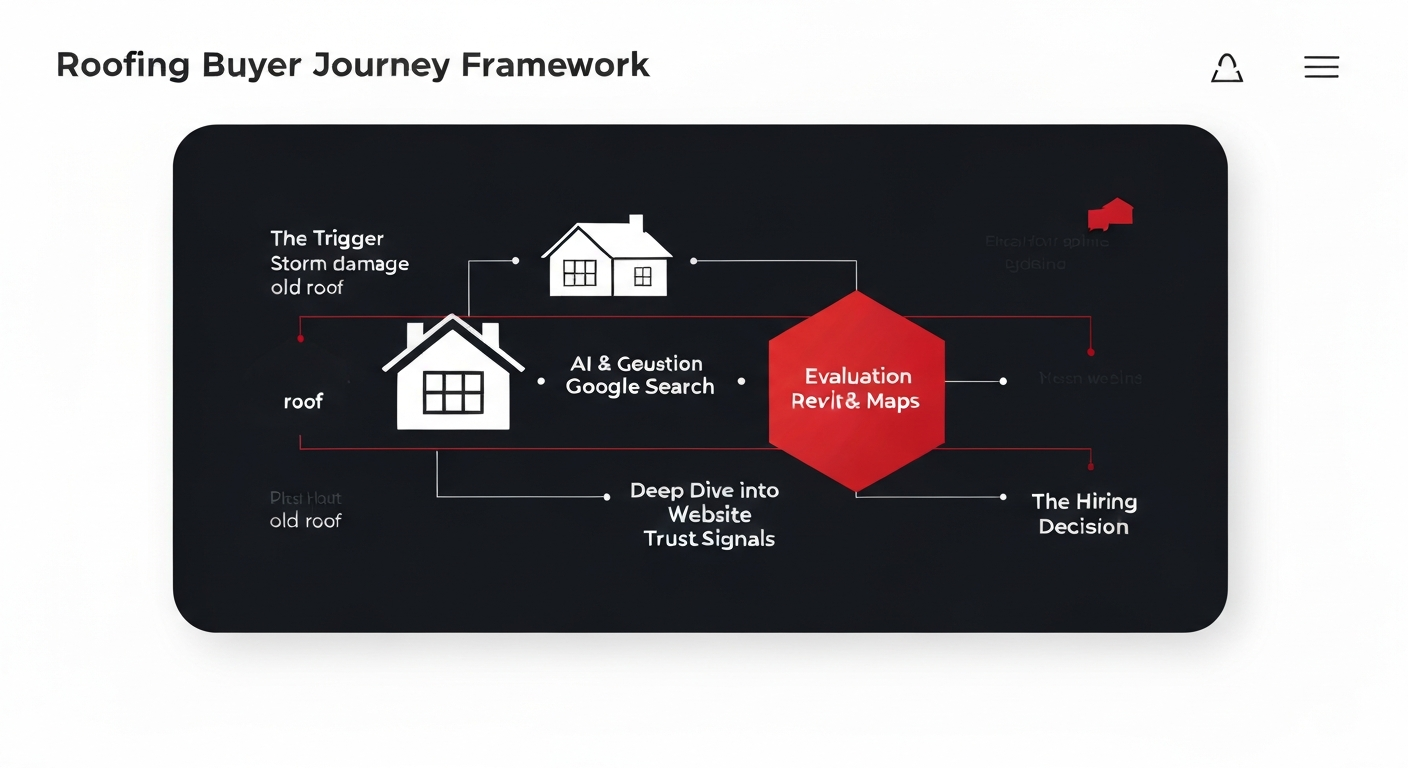
Your marketing strategy must intercept the homeowner at every stage of this journey. If you only focus on the bottom of the funnel (e.g., "Call Now" ads), you miss out on the homeowners who are in the critical research phase.
The Roofing Visibility Pyramid
To dominate your local market, you need a structured approach. We use the Roofing Visibility Pyramid to build compounding authority.

The Base: Website & Trust Signals
Your website is the final destination for all your marketing efforts. If it looks outdated, loads slowly, or lacks trust signals, all your SEO and AEO efforts are wasted. A high-converting roofing website in 2026 must have real photos (no stock imagery), clear service offerings, prominent reviews, fast load times, and easy contact options.
Want to master website optimization? Read our complete Roofing Website Guide to learn exactly what trust signals convert visitors into booked estimates.
The Middle: Local SEO & Google Business Profile
The Google Local Pack is the single largest driver of high-intent roofing leads. The top 3 Google Maps results capture a large share of all local clicks. To dominate the Local Pack, you need more than just a verified profile. You need active management: correct primary categories, consistent review velocity, geotagged photos, and weekly posts.
Need to rank higher in Maps? Discover our exact optimization framework in the Roofing Google Business Profile Guide.
Beyond your headquarters, you need to rank in surrounding suburbs. Google prioritizes proximity. To rank in neighboring cities, you need a robust Local SEO strategy centered around dedicated Service Area Pages.
Struggling to rank outside your city? Learn exactly how to structure your service area pages in our comprehensive Roofing SEO Guide.
The Peak: AI Visibility & Answer Engine Optimization (AEO)
This is the frontier of roofing marketing. Traditional SEO focuses on getting your website to rank on the first page of Google. Answer Engine Optimization (AEO) focuses on getting your business recommended by AI tools like ChatGPT, Gemini, Claude, Perplexity, and Google AI Overviews. A growing share of users now incorporate AI chat tools into their daily search behavior.
When a homeowner asks an AI, "Who is the most reliable roofer in my area for storm damage?", the AI looks for Entity Authority. It scans the internet to see which business is mentioned most consistently across trusted sources. If your digital footprint is limited to just your website, AI tools will not recommend you. You must become the business AI recommends.

Want to be recommended by ChatGPT? We cover this extensively in our upcoming Roofing AI Visibility Guide.
| Feature | Traditional SEO | AI Visibility & AEO |
|---|---|---|
| Primary Goal | Rank on page one for specific keywords | Be the direct answer/recommendation from AI |
| User Experience | Scrolling through 10 blue links | Conversational, zero-click answers |
| Key Signals | Backlinks, keyword density, site speed | Entity authority, cross-platform mentions, sentiment |
Online Reviews: The Ultimate Trust Signal
Online reviews are not just a nice-to-have; they are the currency of trust in 2026. Studies show that a vast majority of consumers read reviews before choosing a local business. Reviews impact your Google Maps rankings, your AI search recommendations, and your ultimate conversion rate.
You cannot hope customers leave reviews; you must have an automated system to request them immediately after a job is completed.
Need more 5-star reviews? Discover our exact frameworks in the upcoming Roofing Reviews Guide.
Educational Authority & Content Marketing
To build trust with homeowners and authority with search engines, you must become an educational resource. Homeowners have questions about insurance claims, material costs, and identifying storm damage. If you answer them clearly and honestly, you win their trust.
This content captures long-tail search traffic and feeds AI engines the facts they need to recommend you.
Not sure what to write about? We detail this strategy in our upcoming Roofing Content Marketing Guide.
Video Marketing for Roofers
Video builds trust faster than any other medium. A simple video of the owner explaining the process, or a drone shot of a completed project, humanizes your company.
Want to start using video? Learn how to leverage short-form and long-form video in our upcoming Roofing Video Marketing Guide.
The Media Surge Visibility Engine™ (MultiCasting)
Creating great content is hard work. Writing a blog post, filming a video, and posting on social media takes time that most roofing owners do not have. At Media Surge Marketing, we solve this with our Create → Repurpose → Distribute methodology, powered by our Visibility Engine™.

Instead of creating dozens of separate pieces of content, we focus on one core asset per month. We then repurpose that single asset into a blog post, a video, a podcast, an infographic, a news article, and social media posts. We distribute these formats across 300+ high-authority platforms. This strategy builds long-term digital assets instead of rented attention.
Lead Nurturing & Conversion Optimization
Generating traffic is useless if it doesn't turn into booked appointments. You need automated lead nurturing—using AI chat agents and automated SMS follow-ups—to ensure no lead falls through the cracks.
Losing leads because you can't answer the phone? Learn how to maximize your ROI in our upcoming Roofing Lead Generation Guide.
| Approach | Paid Leads (Angi, Ads) | Owned Authority (Media Surge) |
|---|---|---|
| Lead Quality | Shared with 3-5 competitors | Exclusive, high-intent inquiries |
| Longevity | Stops the moment you stop paying | Compounds and grows over time |
| Positioning | Competing on lowest price | Competing on trust and expertise |
Your 90-Day Roofing Marketing Roadmap
If you want to start building sustainable digital authority today, follow this 90-day roadmap:
Days 1-30: The Foundation
- Claim, verify, and fully optimize your Google Business Profile.
- Audit your website for speed, mobile responsiveness, and clear trust signals.
- Implement an automated system to request reviews from every customer.
Days 31-60: Content and Expansion
- Identify the top 5 questions your customers ask and publish comprehensive answers.
- Create dedicated Service Area Pages for the top 3 surrounding cities you want to target.
- Ensure your business Name, Address, and Phone number (NAP) are consistent across all directories.
Days 61-90: Authority Building
- Begin repurposing your content into videos and infographics using the MultiCasting methodology.
- Distribute your content across local news sites, social media, and industry directories.
- Track your organic impressions, Map Pack rankings, and AI visibility metrics.
Conclusion
Here's your roadmap.
Recap:
- Build trust.
- Optimize Google Business Profile.
- Publish educational content.
- Create authority.
- Repurpose.
- Distribute.
- Become the company AI recommends.
Marketing a roofing company doesn't have to be a guessing game. It requires a systematic approach to visibility. If you are ready to stop renting attention and start generating exclusive, high-intent leads, it is time to take control of your digital presence.
Schedule a free 30-minute strategy call today, and we'll show you exactly what AI search currently says about your business and where the gaps are.
Frequently Asked Questions
How much should a roofer spend on marketing?
Most successful roofing companies reinvest 5-10% of their gross revenue into marketing. For aggressive growth, this can push closer to 12-15%. The key is shifting spend away from shared leads toward owned assets like SEO and AI visibility that compound over time.
Is SEO worth it for roofers?
Yes. While Google Ads stop the moment you stop paying, SEO builds compounding authority. Once you rank in the Local Pack and organic results, you generate high-intent, exclusive leads at a much lower cost-per-acquisition over the long term.
Should I run Local Services Ads (LSAs)?
LSAs (Google Guaranteed) are a great supplemental strategy because they sit at the very top of the search results and you only pay per lead. However, they should not replace your organic SEO strategy, as LSA costs continue to rise and you do not own the placement.
Do AI Overviews matter for roofing?
Absolutely. Google is increasingly showing AI Overviews for complex queries like 'best roofers near me for hail damage' or 'how much does a new roof cost in [city].' If you aren't optimized for Answer Engine Optimization (AEO), you won't appear in these AI-generated answers.
Should I hire a marketing agency?
If you have the time, expertise, and resources to consistently publish content, optimize your Google Business Profile, and distribute your brand across hundreds of platforms, you can do it in-house. Most roofing owners hire an agency to ensure it's done systematically while they focus on running the business.
How long before SEO works?
You can often see improvements in Google Maps visibility within 60 to 90 days of proper optimization. However, significant ranking gains across competitive keywords and surrounding cities typically take 6 to 12 months of consistent effort.
Can I do this myself?
Yes, you can manage your own Google Business Profile and write your own blogs. The challenge is consistency and scale. Competing in 2026 requires distributing content across hundreds of platforms and optimizing for AI, which is difficult to manage without dedicated tools and expertise.
What is the best marketing strategy for a roofing company in 2026?
The best strategy is a blended approach that builds long-term authority. This includes optimizing your Google Business Profile for the Local Pack, implementing Local SEO with dedicated service area pages, generating consistent 5-star reviews, and using Answer Engine Optimization (AEO) to ensure AI tools like ChatGPT recommend your business.
Should roofing companies buy leads from HomeAdvisor or Angi?
While it can provide short-term activity, buying shared leads is generally a poor long-term strategy. You are paying for leads that are sold to multiple competitors, forcing a race to the bottom on price. It is much more profitable to invest that budget into your own SEO and digital authority to generate exclusive leads.
How does AI search affect roofing marketing?
Homeowners are increasingly asking AI tools like ChatGPT for recommendations instead of just using Google Search. AI tools recommend businesses that have strong 'Entity Authority'—meaning they are consistently mentioned across authoritative websites, have excellent reviews, and publish helpful content. Optimizing for AI is now a critical part of roofing marketing.
How important are online reviews for roofers?
Online reviews are one of the most critical factors in roofing marketing. They not only serve as the ultimate trust signal for homeowners evaluating your business, but they are also a major ranking factor for Google Maps and AI search engines. You need a system to consistently generate new, positive reviews.
How do I get more roofing reviews?
The best way to get more reviews is to automate the ask. Use a reputation management system that sends an SMS and email request immediately after a job is marked complete. Make it as easy as possible by providing a direct link to your Google Business Profile.
Should I respond to negative reviews?
Yes, always. A professional, calm response to a negative review shows future customers that you care about your reputation and are willing to make things right. Never argue online; instead, offer to take the conversation offline to resolve the issue.
What is Answer Engine Optimization (AEO)?
AEO is the process of optimizing your digital presence so that Answer Engines (like ChatGPT, Perplexity, and Google AI Overviews) recommend your business. It focuses on building entity authority, answering specific questions, and earning cross-platform citations.
Does social media work for roofing companies?
Yes, but mostly as a trust signal and for brand awareness. Homeowners might not hire a roofer directly from a Facebook post, but they will check your Facebook page to see if you are a real, active business with recent projects and happy customers.
Should I buy a new website for my roofing business?
If your current website is slow, not mobile-friendly, or lacks clear calls-to-action and trust signals, then yes. A high-converting website is the foundation of all your marketing efforts. Sending traffic to a bad website is a waste of money.
What is MultiCasting?
MultiCasting is our proprietary content distribution system. We take one core piece of content (like a blog post), repurpose it into 8 different formats (video, podcast, infographic, etc.), and distribute it across 300+ platforms to build massive digital authority.
How much does a roofing lead cost?
The cost of a roofing lead varies wildly depending on the source. Shared leads from Angi might cost $50-$150, but they convert poorly. Google Ads leads can cost $150-$400+. Organic leads generated through SEO and AEO have the lowest long-term cost-per-acquisition and the highest conversion rate.
Why did my Google Maps ranking drop?
Google Maps rankings can fluctuate due to algorithm updates, new competitors entering the market, a lack of recent reviews, or inconsistent NAP (Name, Address, Phone) information across the web. Regular posting and review generation help stabilize rankings.
Is email marketing effective for roofers?
Email marketing is highly effective for staying top-of-mind with past customers for maintenance, referrals, and seasonal inspections. It is less effective for cold lead generation, but excellent for nurturing leads who requested a quote but haven't decided yet.
John Simpson, Co-owner
John Simpson is the Co-owner of Media Surge Marketing and creator of the SURGE Framework™, a proprietary methodology that helps local service businesses become the companies Google and AI recommend.
Specializing in AI visibility, local SEO, Answer Engine Optimization (AEO), and content strategy, John combines real-world client experience with ongoing research to help businesses build trust and improve their online visibility.
Ready to Implement
These Strategies?
Stop losing leads to competitors who are already optimizing for AI Search. Let's build your custom authority roadmap.
